Applying regulated electricity rates to the prepaid sales system: same rates for post-paid and prepaid


.
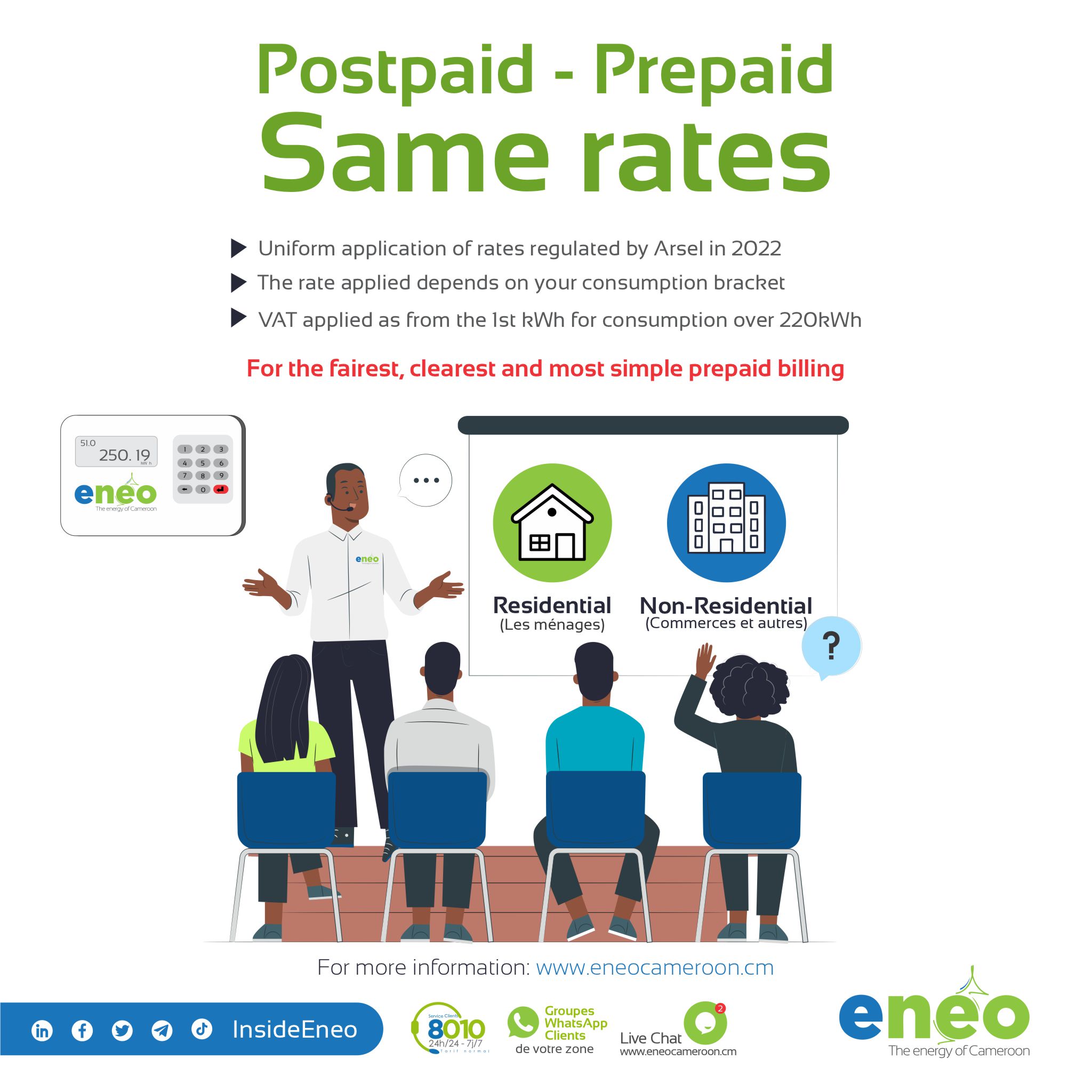
As requested by the regulator, Eneo will apply, as from 1st November 2024, rates regulated by the Electricity Sector Regulatory Agency (ARSEL) to the existing two modes of consumption : prepaid — when a customer buys and enters an electricity token before consuming — and postpaid — when a customer is billed at the end of the month.
After a transitional period that made it easy for over 800, 000 households and companies to access the prepaid solution, in accordance with conclusions from the meeting that took place between ARSEL, consumer associations and Eneo in March 2023 in Mbankomo and the meeting that took place on 23 October 2024, Eneo has to apply to prepaid customers the only rate decision that exists since 2012.
This alignment is important for three reasons:
Fairness:guarantee that all consumers regardless of their mode of consumption (prepaid or postpaid) are billed on the same basis.
Transparency:guarantee clarity and the ability of all our customers to understand the rates.
Simplicity:simplify the basic rate structure, so that customers can better understand bills
In fact, this is a harmonisation drive that falls within the framework of enforcement of electricity rates set as decided by the Regulator on 28 March 2012 with classification of low voltage customers into two groups: residential and non-residential
Furthermore, this drive does not change the principle that informs electricity rates in Cameroon: modest consumption, low rates; “comfort” consumption, higher rates.
Similarly, the underlying prepayment principle remains the same. During a cycle that runs from the first to the last calendar day of each month, billing is done based on the combination of kWh bought.
The prepaid meter is a solution that offers genuine benefits: greater autonomy, better budget management, great flexibility, and more security among other things.
What has changed:
- Customers are no longer segmented based on installed voltage : a customer is either residential or non-residential.
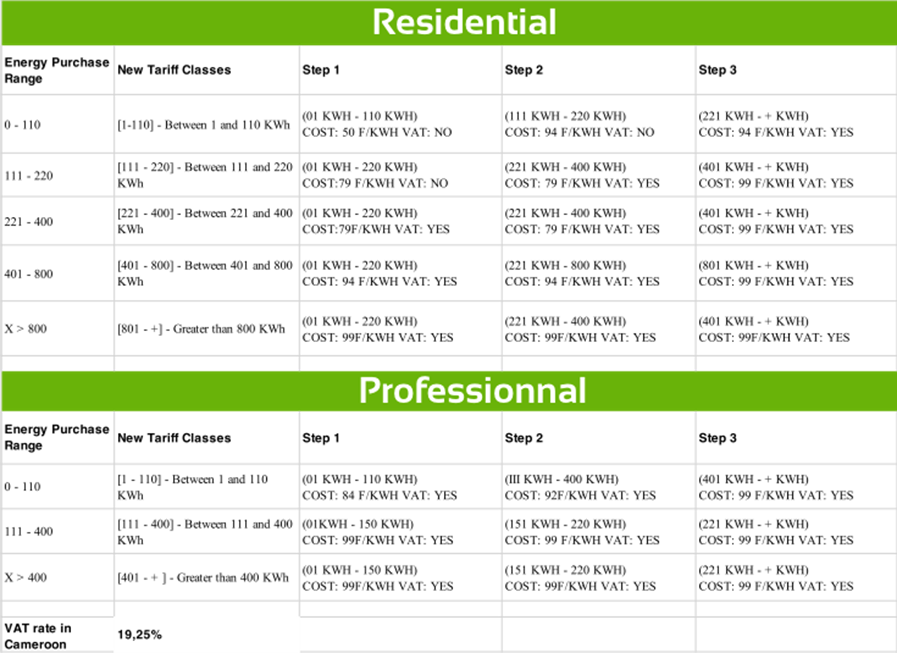
- Based on recharge habits, each customer fits into a consumption bracket that determines the rate that applies to them. A customer's routine average consumption and use make it possible to fit them into a rate bracket in the May 2012 decision.
- For a customer, within the same month and in case they exceed the upper limit of the initial bracket to which they are assigned, the comfort rates in the published rate schedule (see steps 2 and 3 of the rate schedule) will be applied to the additional kilowatt-hours they buy.
- At the end of each month, assessment of the customer's average consumption over the past 6 months makes it possible to fit them into the corresponding regulatory bracket. The rate for this bracket will be applied to the said customer in the following month.
- Any consumption above 220 kWh will be subject to payment of VAT as from the 1st kWh bought.